
Medical Scheme Legislation
Medical Schemes are required to comply with the legislation as specified in the Medical Schemes Act 131 of 1998. A trustee of a medical scheme has the fiduciary duty to protect the scheme against any undue financial or underwriting risks.
You may therefore be confronted with some or all of the following underwriting decisions when you apply for membership of a medical scheme:
- 3-months general waiting period
- 12-months condition specific exclusions
- Late Joiners Penalty
3-months general waiting period
A medical scheme may impose a general waiting period of up to three months upon a new member and the member’s dependent(s) before such member or dependent(s) is entitled to claim any benefits.
This 3-month general waiting may be imposed in the following instances:
- when application is made for membership or admission as a dependant who was previously a beneficiary of a medical scheme for a continuous period of more than 24 months, terminating less than 90 days immediately prior to the date of application.
- when you have not been a member of a medical aid scheme in the last 90 days immediately preceding your new application.
A condition-specific waiting period
The Act describes a condition-specific waiting period as a period during which a beneficiary is not entitled to claim benefits in respect of a condition for which medical advice, diagnosis, care or treatment was recommended or received within the twelve-month period ending on the date on which an application for membership was made.
The condition-specific waiting period may be imposed in the following instances:
- when application is made for membership or admission as a dependant who was previously a beneficiary of a medical scheme for a continuous period of up to 24 months, terminating less than 90 days immediately prior to the date of application.
- when you have not been a member of a medical aid scheme in the last 90 days immediately preceding your new application.
when you have been a member of a previous medical scheme for less than 24 months and you apply to join the new medical scheme within 90 days of your cancellation from the previous medical scheme, but the change of medical scheme is requested on a voluntary basis.
Late Joiners Penalty (LJP)
The LJP is calculated according to a fixed formula that has been determined in the Regulations to the Medical Schemes Act. The longer a person waits to join a medical scheme after the age of 30, the higher the late joiner penalty that will be applied by the scheme.
If you have been a member of a registered medical aid scheme, then this will count in your favour. This is referred to as “creditable coverage” in the relevant legislation. Remember that the scheme will require that you provide proof of such prior medical scheme membership.
To calculate the applicable LJP, the following formula can be used:
A = B minus (35 + C)
“A” is the number of years referred to in Column 1 in the table below.
“B” is you current age,
“C” is the number of years that you were a member of a registered medical aid scheme (but not including the number of years when the member was a member of a medical scheme as a dependent under the age of 21 years).
To demonstrate this with an example:
Column 1 | Column 2 |
The number of years that the applicant was not a member of a registered medical aid scheme after the age of 30. | Maximum late joiner penalty |
1 to 4 years | Normal monthly contribution multiplied by 1.05 |
5 to 14 years | Normal monthly contribution multiplied by 1.25 |
15 to 24 years | Normal monthly contribution multiplied by 1.50 |
More than 25 years | Normal monthly contribution multiplied by 1.75 |
The member is currently 70 years old. The member has been an adult member of a previous medical aid scheme(s
) for a total of 20 years,
The normal contribution (before the imposition of the LJP) is R1 200.00 per month.
A = B minus (35 + C)
A = 70 minus (35 + 20)
A = 70 minus 55
A = 15
Now, refer to Column 1 in the table. In this case, the member will therefore have a late joiner penalty of 1.50 times the normal monthly contribution applied to his payment each and every month. The contribution will therefore increase from R1,200 to R1,800 per month. Note that the penalty portion will not be added to the savings portion of your monthly contribution. The above calculation therefore assumes that no saving contributions are applied to this medical scheme option.
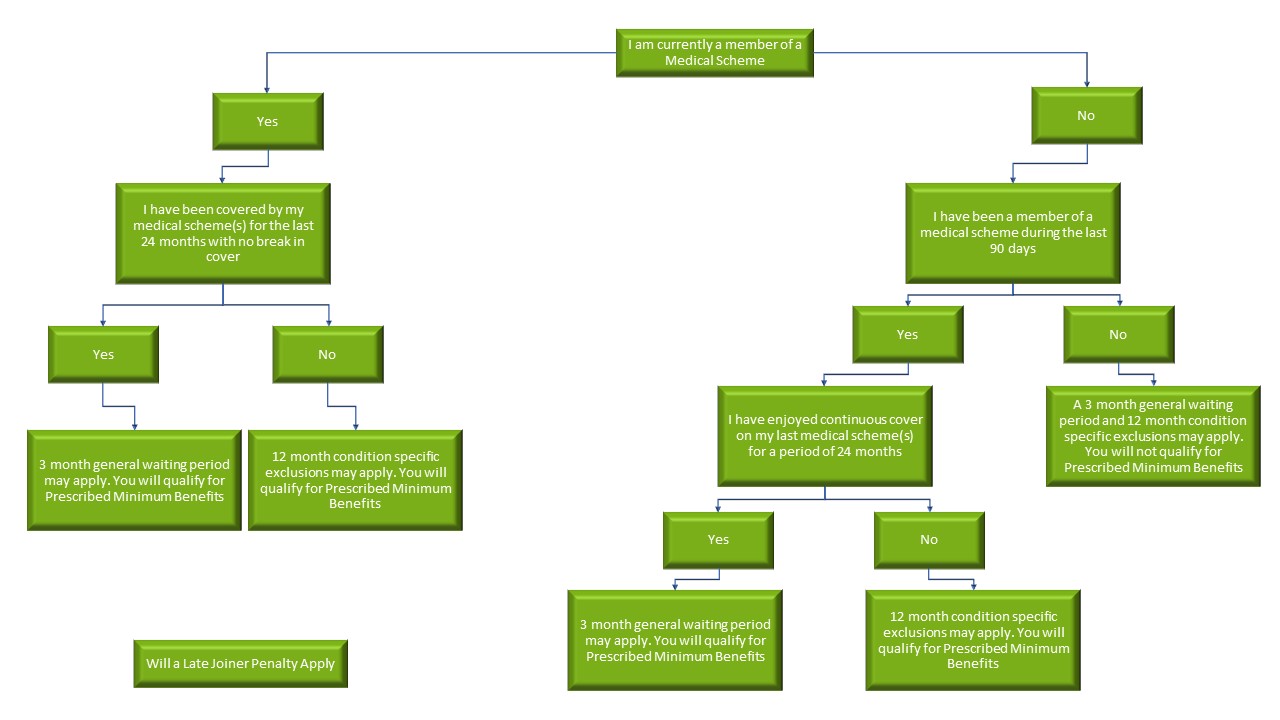
This diagram explains the waiting period. Click on the image to see it in full screen.